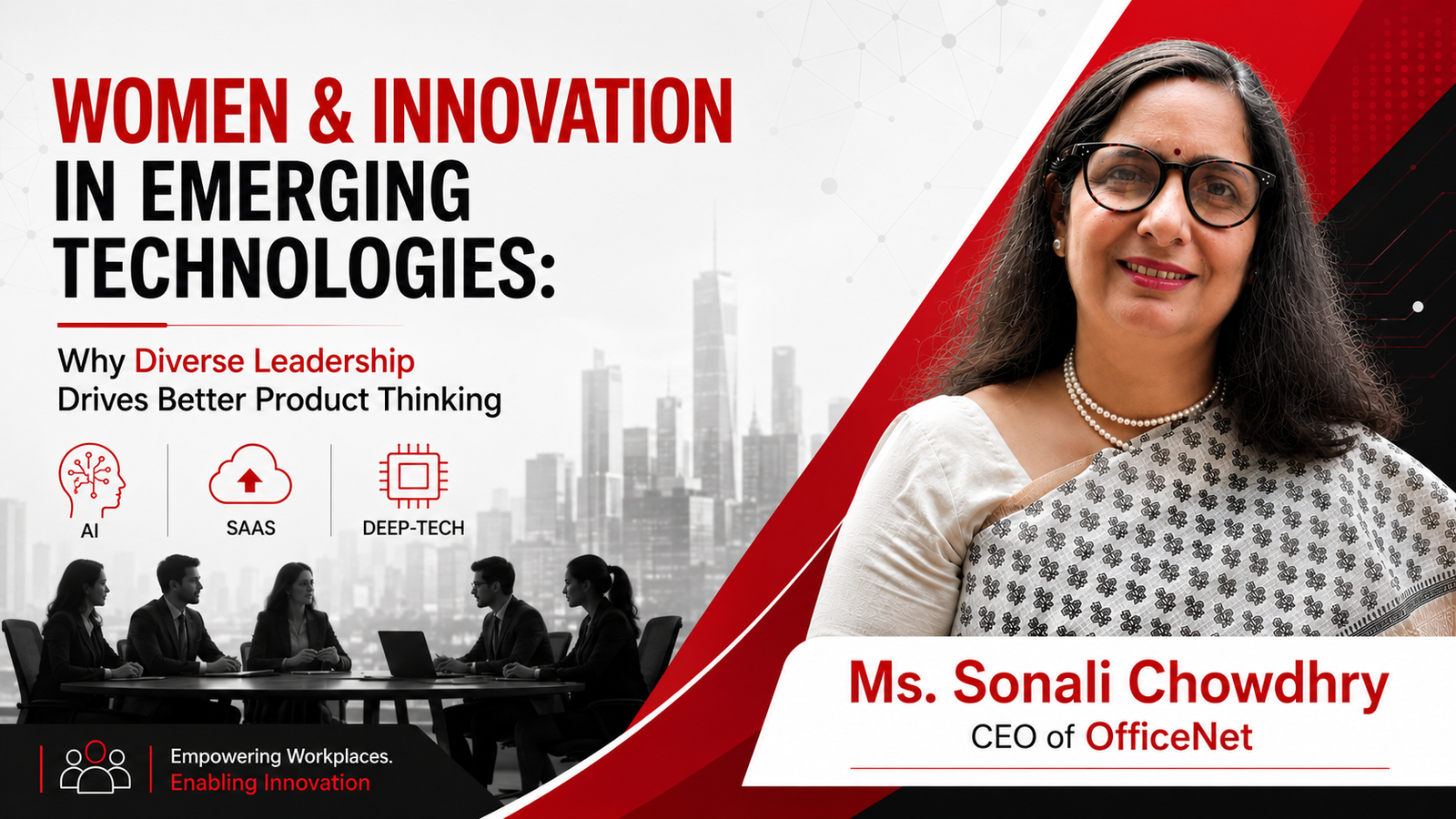
At a time when artificial intelligence, SaaS platforms, and deep-tech solutions are rapidly reshaping how businesses operate, there’s another shift quietly taking place, the growing presence of women in leadership roles within these ecosystems. While the numbers are still evolving, their influence on how technology is being built and experienced is already making a difference.
For Sonali Chowdhry, CEO of OfficeNet, the journey into entrepreneurship didn’t start with a big plan, it grew over time. Early in her career, she worked closely with organizations and teams, where she saw first-hand how much time and effort went into managing people and processes. “A lot of it felt more complicated than it needed to be,” she shares. “There were gaps that affected not just efficiency, but also the overall employee experience.”
Those early observations stayed with her. What started as curiosity slowly turned into a deeper interest in solving these challenges in a more meaningful way. Taking the leap into entrepreneurship wasn’t without its uncertainties, like building the right product or earning trust in a competitive space, but it was driven by a simple idea: technology should make things easier, not harder. That thinking eventually led to OfficeNet, a platform designed to simplify workforce management while staying intuitive and adaptable to real business needs.
Her journey also reflects a broader truth about innovation, who builds technology shapes how it works. In areas like AI, where systems learn from data and patterns, diverse perspectives become critical. Women in tech bring a different lens to product thinking, helping reduce unconscious bias and making solutions more inclusive. “Technology touches so many aspects of people’s lives,” Sonali says. “It’s important that the people building it reflect that diversity.”
This diversity naturally strengthens problem-solving as well. When teams bring different viewpoints to the table, they tend to approach challenges more thoughtfully, often leading to more practical and creative solutions. In fast-moving sectors like SaaS and deep-tech, that ability to think differently can make all the difference.
There’s also a noticeable impact on work culture. Women leaders often foster more open, collaborative environments where ideas can be shared freely and teams feel more connected to what they’re building. At OfficeNet, this translates into a strong focus on usability and continuous feedback, ensuring the product evolves with real user needs.
At the same time, representation itself plays a powerful role. Seeing more women step into leadership positions in technology makes the path feel more accessible to others. “Sometimes, just knowing that someone has done it before you can make a big difference,” Sonali reflects.
As more women enter AI, SaaS, and deep-tech ecosystems, the focus is gradually shifting from diversity as a conversation to diversity as a clear advantage. For women entrepreneurs across India, this moment offers both opportunity and encouragement, to not just be part of the ecosystem, but to help shape it. Because in the end, innovation isn’t just about building smarter systems, it’s about building systems that work better for people.
<p>The post Women & Innovation in Emerging Technologies: Why Diverse Leadership Drives Better Product Thinking first appeared on Hello Entrepreneurs.</p>